Today is November 18, 2016. I want you to write about who you are, what you have experienced, and what you have endured.
Write down what you value; what standards you hold for yourself and for others. Write about your dreams for the future and your hopes for your children. Write about the struggle of your ancestors and how the hardship they overcame shaped the person you are today.
Write your biography, write down your memories. Because if you do not do it now, you may forget.
Write a list of things you would never do. Because it is possible that in the next year, you will do them.
Write a list of things you would never believe. Because it is possible that in the next year, you will either believe them or be forced to say you believe them.
A president-elect who wants to strip our country down for parts
It is increasingly clear, as Donald Trump appoints his cabinet of white supremacists and war-mongers, as hate crimes rise, as the institutions that are supposed to protect us cower, as international norms are shattered, that his ascendency to power is not normal.
They lacked for nothing, and they indulged every whim with matter-of-fact entitlement. If Christina saw a piece of jewelry she liked, she bought it. If Paul found a designer suit that struck his fancy, he purchased it. If either of them discovered an expensive trinket that piqued their interest, they acquired it. When they were hungry, they ate as much as they pleased of whatever cuisine they desired. When their car ceased to be fashionable, they traded it in for another. When they spilled wine on a piece of furniture, they had the whole suite replaced. If anyone got in Paul’s way at work, he used his professional influence to have them removed from his path. When Christina decided she needed more money, she adjusted her prices and secretly kept the extra profit for herself. Their lives overflowed with an uninhibited, entitled abundance which they increasingly took for granted, and all their friends affirmed their right to take as much as they chose from the world around them.
Yet for all they had, it was never enough. They were intent on acquiring even more.
Each day, they sallied forth from their high-rise condo into the world of commercial enterprise which compliantly awaited their bidding. Each day, both Paul and Christina spent long hours at their jobs―he, behind a desk or in board rooms, she, walking clients through her gallery, showing what style and magic could be had from indigenous imagination and traditions, or meeting with artists anxiously seeking a venue for their work. Late in the evening, they headed home for drinks and dinner. Some nights, they dined on takeout in front of the television, work papers spread about them on the floor. Other nights, they donned their finest evening wear and attended posh, paparazzi-spangled social affairs with politically connected business associates and the pillars of the community they called friends. The only sign of limitation in their lives was that they had no driver, yet, and their car was a mid-sized (albeit, luxury) sedan. But soon enough, they had every confidence, their Mercedes would be replaced by a town car―like those of the silver-haired lords and ladies of the city―and a hired man, not Paul, would chauffeur them to the fêtes.
In return for the intense ardor of their daily lives and their devotion to keeping up appearances, they were richly rewarded with social and professional advancement. Mastery of their universe was well worth every 18-hour workday, followed by long evenings of paperwork or parties. Like others in their social milieu, they paid little attention to politics, unless it directly affected their social or professional positions, and they paid even less attention to the implications (moral or social) of their work. They were eagerly and intentionally devoid of any ethically responsible impulse, and they considered social consciousness the bastard child of the morally invasive Church. Their only profession of faith was that those who had less than they, had been somehow remiss in their socio-economic or karmic obligations, to live such meager lives. Those who had less, they believed, were either lazy or stupid and had earned their low station in life. Everyone, they believed, got exactly what they deserved.
Paul and Christina had it all, and they assumed they deserved no less.
Image content: Limited by their upbringing, social position, and isolation from older radical traditions, 1960s activists were unable to make the connections and changes required to build movements strong enough to survive and eventually win structural change in the United States. Middle-class students did not sufficiently ally with working and poor people. Too few white activists accepted third world leadership of multi-racial alliances. Too many men refused to practice genuine gender equality. Originally motivated by goals of quick reforms, 1960s activists were ill-prepared for the long-term struggles in which they found themselves. Overly dependent on media-oriented superstars and one-shot dramatic actions, they failed to develop stable organizations, accountable leader ship, and strategic perspective. Creatures of the culture they so despised, they often lacked the patience to sustain tedious grassroots work and painstaking analysis of actual social conditions. They found it hard to accept the slow, uneven pace of personal and political change.
I’m working my way through posting excerpts of Strange Bedfellows on this site. The book seems even more apropos now, than ever before, so I’m working my way through it. I hope people will come to understand the underlying message that transcends the story itself. There’s a lot in there. I’ve had 25+ years to think about it, and trust me, I don’t waste time thinking about stuff that has no purpose.
Since the election, there’s been a tremendous amount of dismay, cries for justice, and demands to know “How Can This Happen?”
There’s been a palpable change in the atmosphere. I’m not one to be alarmist, or call out people who stereotypically seem inclined to mis-behave towards others not like themselves (that would be straight, white, middle-class men). But on my conference calls at work, I notice a different tone in the discussions. Men who used to take their turn in the conversations are now dominating. And the way they dominate has changed, as well. Their tone is more imperious, while the things they have to offer are somehow less sophisticated than before.
Then again, maybe they’re just having bad days. Maybe they’re nervous, along with all of us, and that’s how they work it out. I tend to give people the benefit of the doubt. Plus, I’m more sensitive these days, than usual. (Aren’t we all?)
But something feels different.
It feels like we’ve regressed.
Now, mind you, I’m not one of these pie-in-the-sky Obama’s-presidency-made-it-all-better kind of libbral. I’ve never believed we live in a post-racial America. Impossible, is what comes to mind, when I hear people suggest that. It’s hard for me to trust the professed open-mindedness of privileged and entitled individuals, no matter how well-meaning they may be, no matter how closely they may hew to the more genuine side of that fine line that separates “PC” behavior from true consideration and respect for others different from themselves. It takes a lot to earn my queer trust, my intermittently disabled confidence, my inherently marginalized regard.
Maybe I’m just too cynical. I’ve been battin’ around on this planet for 50-odd years, and maybe my experiences have hardened me. I’ve seen a lot of positive change in the past decades, but I must admit, I don’t expect much. Not from the mainstream, no matter how its members may cast themselves in ally roles in the grand screenplay of my life. People become strangely aloof, when they risk losing something they prize, just because they’re seen with you. Most of all, I’ve been suspect of the supposed normalization of same-sex marriage, nationwide. It’s one thing for my current home state of Massachusetts to legalize and recognize my 26-year committed, monogamous relationship (i.e., allow me to visit my partner in the hospital and help make critical healthcare decisions for her, as well as let me transfer along to her the finances she’s helped me build). But expecting the law of the land to win over the rest of the bright-red country, and warm the cockles of the hearts of the heartland… Yeah, not so much.
Don’t get me wrong. I want to believe. I want to know to the marrow of my bones that people can and will choose dignity over disgrace, and that they truly are capable of change. And I was starting to believe — just a little bit more — when all the polls showed Hillary Clinton well in the lead, and everyone was pretty much taking for granted that she was going to win over her opponent.
But now this. Now the results of the election — which, if you’re paying attention, are so suspect that they bar even the faintest appearance of legitimacy. We were hacked. Repeatedly. And not just during the November election time. For months, it’s been going on. Our national security authorities have said so. Cybersecurity experts say so. And the results from the digital voting machines in counties that had no paper backups don’t even resemble the results of counties next door which had paper ballots as well.
Why are we surprised that the results came out so different than 96.875% of the official pollsters predicted? Why are we surprised at the suggestion we might have been hacked? Why would we doubt it? It just seems so obvious to me. And yet, the disbelief and denial have flowed like rancid milk from a carton dropped on the kitchen floor after it was left in the fridge during a 2-week power cut. Following that disbelief and denial about the kind of world we live in has come a steady stream of calls for normalization from all sides.
People who still believe that “love trumps hate” — and who don’t seem to get that giving your opponent airtime by using his name in your #1 slogan is not a great way to diminish his impact.
People who just want to accept things as they are and move on.
People who can’t fathom just how bad things can get for this country, thanks to the events of this month, and who can’t wrap their minds around the idea that America’s democracy – of all places – could fall to a fascist coup.
People who want to make the best of things, build bridges, find the good in whatever situation comes.
People who don’t want to rock the boat — and end up on somebody’s list that gets them “disappeared”.
In moments like this, I despair. Because this is really nothing other than realpolitik, plain and simple — the cold, hard facts of political practicalities, and what happens when you ignore them. And so many reactions after that obvious travesty of an election result have treated it like it was a final sentence. A done deal.
People, this is not over. The Electoral College still has to vote. Heck, our popular election was really just an indicator of which way the Electors should vote. There’s no guarantee they’re going to give it to Trump, though it wouldn’t surprise me if they caved and did just that. On top of it all, there are untold numbers of existing and potential legal suits to raise against the prematurely-declared “President-Elect”, despite the insipid sycophanty of people who only a few weeks ago were questioning the mental health of that individual.
My point is, we’re way too quick to just cave. We’ve come a long way from the original settlers (who were no saints, themselves), to the political hothouse flowers we are today. I would imagine the earth above our founding fathers’ (and mothers’) graves is mighty churned up, right about now.
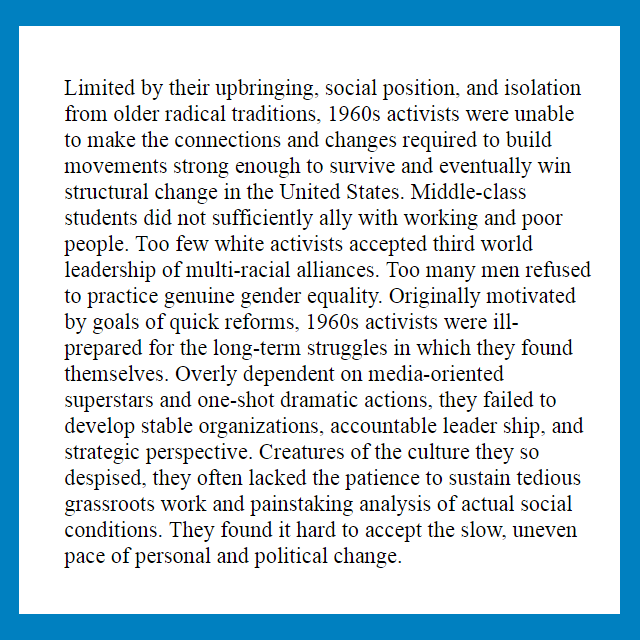
What’s happened to us? Are we really that weak, really that brittle, really that passive, that all it takes is a surprising show of strength (about things which we had every reason to expect)? Why so timid? Why so quick to roll over? It’s like in the quote above, from the online book WAR AT HOME: Covert Action Against U.S. Activists and What We Can Do About It, our progressives simply doesn’t seem to have what it takes to stand up and fight for themselves — or the rest of us — or to even realize that it takes more than eight years of an African-American president to prove America is over its backwards ways.
Thing is, we just can’t seem to figure out how to instill lasting change in our world. Especially from the left. We have some wins, and we shout “Hooray! All better now!” and urge everyone who’s still smarting from the burn of institutionalized racism, sexism, classism, and bigotry of all kinds, to just move on. Deal with it. See? We’re so much more evolved now.
Except we’re not. Not even close. We’ve managed to plaster over the cracks in the structurally unsound lath and whitewash the walls, but the cracks are still there, and the house is still shaky. We’ve managed to make some symbolic gestures that show how much cooler we are with people of color, disabled folks, queers, women, and so forth, and we know how to talk in terms that don’t instantly offend. But the underlying foundation of all this… bullshit… well, that hasn’t actually changed.
And so we find ourselves back in the same goddamned situation as before — only each time, it seems worse. And it is worse. Because while you were celebrating our post-racial world and congratulating yourself for reading writers of color, the KKK was still demonstrating in Lancaster, PA. Disabled folks (especially non-whites) were still getting shot and killed by police officers. Shooters were still stalking law-enforcement and executing them. And no, the Recession is not over. Not by a long shot.
You want a revolution? Then quit talking. Look to the long game. See the ways in which you can extend the significant changes throughout your life. And for God’s sake, don’t just do it because all of a sudden, you got scared or intimidated or had a wake-up call… and then forget all about it, when you start to feel better about yourself and your choices.
Change isn’t something you can instigate, and then leave to flourish on its own. It takes work, it takes commitment, it’s a fucking boring slog much of the time, and thankless most of the time… and unless we keep after it, it cannot last.
So, enough of the wailing and gnashing of teeth. Whatever caused this shit-show, it didn’t just happen overnight. And it’s not going away anytime soon.
Christina was dark, as well, with long, luxurious tresses that fell over her strong shoulders, almost to her full hips. Her sense of style was less conservative than her husband’s, favoring bright colors and prints, but it was no less expensive. Her gaze was as shrewd as his, and she made no attempt to mask her wits. She ran her own chic “primitive art” gallery and made a handsome living from inflating prices to tap her wealthy clientèle. She passed along little, if any, of the profits to “her” artists.
Together, the couple earned a lot, and their status reflected it. They were well-established amongst the “haves,” and untroubled by the existence and experiences of the “have-nots.” Their social circle consisted of some of the wealthiest and most powerful citizenry, whose favor earned them entrance to all the right parties, all the best clubs.
Their home was in a high-rise in the center of a teeming metropolis, towering above urban squalor that stretched out for miles in all directions. By day, the gray city streets seethed with life that became progressively poorer, the farther they led from the city center, till they terminated in the abject human misery of cardboard-box slums crowded up around steaming, smoking garbage dumps. By night, the brilliant glow of peacock-proud neon bathed the streets in a surreal, electrified mix of optimism, oblivion, and desperation.
With one of the most exclusive addresses in the city, nestled in the safety of privilege’s embrace, their condominium was filled with only the finest furnishings, appliances, and artwork. With its deep pile carpet, immaculate white divan, matching side chairs and Ottoman, and glistening glass-and-metal bookcases and tables holding all their finest collectibles, they were surrounded with spotless, serene luxury high above the throbbing city below. At night, the wide windows of their living room showed no filth in the streets, no beggars or cripples or whores… only miles of light stretching out in every direction far below, masking pain and misery with light and action, thrilling them with the promise of easy conquest.
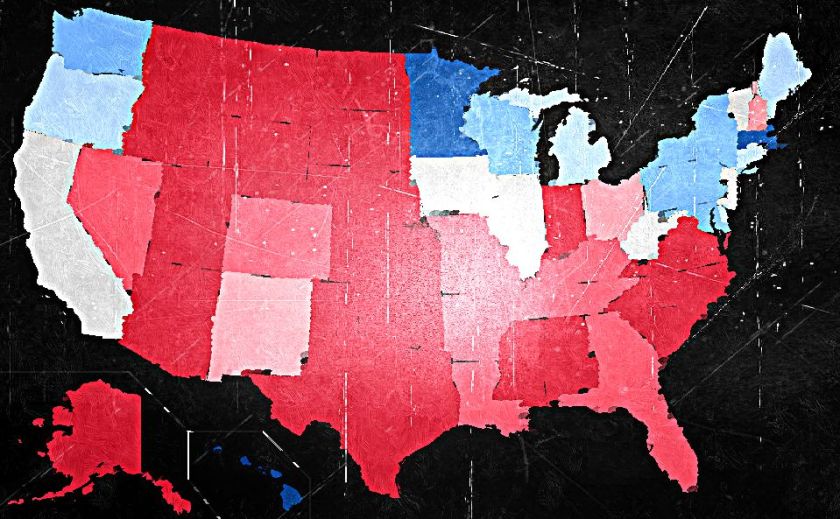
United States Presidential Election Results 1968-2012
I guess it’s time for me to talk about the election. Because… well… it’s the thing to do, this week. I actually got a full 8 hours of sleep last night. The insomnia seems to have abated. For now.
Who’s not thinking/talking about this election at length… perserverating… wondering what-if… and trying to figure out next steps? A minority segment of the population is taking another route, providing a much-needed public service of posting baby animal videos and fart jokes to social media, compassionately playing the clowns to ease the angst of the majority of voters whose candidate conceded the morning after the election. And I thank them for that.
It’s been a little over three days, since the results came in, and it’s been the longest year ever, packed into less than a week.
Probably the most distressing and taxing thing for me, personally, is believing that the results of this election didn’t just magically appear, but are part of the logical progression we as citizens/residents of the United States have collectively been involved in, over the past years… decades… centuries. The alt-right didn’t suddenly drop their cover (as encouraged on Reddit and other online enclaves) and surge forward to elect “their man”. Violence against vulnerable / different people didn’t just start happening since Tuesday night. Swastikas haven’t been spray-painted in public places only since November 9th (that’s been happening increasingly over the past couple of decades). This sort of acting out has been going on for a long, long time, building to a head this week like a boil under the surface of the American skin.
And we’ve participated. All of us. On both sides of the proverbial aisle. We’ve all been complicit, to some extent or another. We’ve been complacent. We’ve wrapped ourselves in the banner of American Exceptionalism and decided for ourselves that “we’re better than that”, all the while ignoring the in-your-face facts of our historical genocide, slavery, the land grabs, the destruction of the earth, and the systematic oppression and violence against anyone and anything who does not Dominate. We’ve cheered on the dominators… when they’ve been on our team. And we haven’t done much to curb our lust for retribution when we’ve been dominated by those “others”. We’ve collectively contributed as an entire nation to this progression, whether directly or indirectly. And all the people reacting to this election’s results with shock and dismay, just shows me how few people have reallybeen paying attention for the past 30 years.
No, wait – the past 300 years.
No, make that 1300 years.
And beyond.
Too many of us have been living in an echo chamber consisting of highly personalized experiences of one sort or another: overwork, over-worry, a steady diet of nervous-system-tweaking television (you know that commercials are specially designed and produced to put you into a persistent, heightened state of alert, right?), networks of social media friends and contacts who not only agree with us but shore up our biases with links to blatantly propagandist pseudo-news and their own personal manifestos, and our flat-out refusal to consider any points of view different from our own. All that customization both increases and reduces the friction in our lives, and in so doing, it saps our resilience. Pinballing reactively between comfort and crisis is no way to build core strength. We’re so caught up in “Don’t think – react!” mode, that we’ve slowly been deconditioned away from complex thought… the ability to connect with others different from ourselves… the ability to be more than blue-pill-popping Matrix power supplies.
And so, it’s extremely difficult for me to take issue with one side over the other. Yes, violence has accompanied the rhetoric and rallies of the leading Republican contender. Yes, his followers have kicked the crap out of a lot of folks, threatened them overtly, plotted large-scale destruction against them. But the violence has been coming from both sides. No one side has been any less or more culpable than the other. And those of us who stood by and made excuses for it or justified it when it was coming from people who agreed with us, were complicit in that sort of behavior. We legitimized it. Because we took sides, and we refused to look further.
Don’t get me wrong. I am categorically opposed to just about everything the current incarnation of the Republican Party stands for and promotes. At the same time — woe is me — I can completely and totally understand where all the right-of-center adherents are coming from. It’s a terrible place to find myself, because I can’t comfortably inhabit just one side of the issue and pretend the other doesn’t matter. It does matter. It has an impact. And I cannot even begin to discount the validity and legitimacy of the very real pain, suffering, and sense of hopelessness that permeates that part of the culture I observe from what I think is a safe distance.
There is no safe distance. Not anymore.
I may be one of the very, very few people around, these days, who feels this way. I’m sure there are others. I’ve read some very good pieces by them. But we’re precious few. The partisan nature of our lives, the “team sports” mentality, the our-tribe-against-their-tribeorientation… it has suffused our public and private lives for so long, it feels normal. Natural. How Things Are Supposed To Be. And now this election happens… and what do we have but a president-elect who embodies the most extreme form of partisanship ever. He’s built his platform on resentment, hate, pain, fear, and the openly expressed desire to tear down the system that so many feel oppresses them — and so many rely on for their survival. It’s now US against THEM in a whole new way — not the ritualized political schism-making we seem to have down to a science, but a cultural rift that we perpetuate gleefully, even as we bemoan the fruits of our actions.
I’ve written about how we’ve gotten in the habit of pretending other people’s pain doesn’t matter before, and it’s time for me to think about it again. A lot. It’s ridiculous, really, how we got ourselves into this situation, but we’re carrying on as though we don’t understand why. The signs were there. They’ve always been there. We just chose to ignore them, because — for the time being — they didn’t work against us. So long as “our guy” won and was in office, and our interests were covered, we were good. We thought it was all good. And a whole new generation of Americans has grown up in a fantasmagorical bubble of thinking that the kinds of behaviors and policies we’re now seeing are anomalous, un-American, and the behavior of deranged individuals who are unhinged from reality.
I’ve got news for you, in case you hadn’t heard — the kinds of behaviors we’ve been seeing leading up to the election and coming immediately afterwards, are exactly the kinds of things you can expect from Americans who have been living under the conditions and with the mindsets that the opposing echo-chamber folks blissfully ignore or discredit. Rev. Dr. Martin Luther King, Jr. said “A riot is the language of the unheard”, which means we haven’t been listening. And we devalue other people at our own risk. The idea that we can pay no attention (la-la-la-la) to the sufferings of select others — whether they’re white or black or brown or red, whether they’re “entitled” to suffer or not — and expect it to never blow back in our faces… it’s just plain delusional. Clearly, our logic and our ability to pay attention and connect the dots has failed us.
Welcome, America. Welcome to the world we have created.
I dreamed of a young husband and wife in their mid-30’s who were privileged upper-class professionals, approaching the high points of their careers. Paul and Christina were beautiful young hopefuls, maturing into accomplished adults, poised and graceful in ways that come easiest to the well-fed, well-dressed and well-connected.
Paul was a tall, dark, calculating man with handsome, chiseled features and wavy hair that he kept cut short to compliment his conservative designer clothing. His tastes ran to the conventional, but always with a flair of expensive, exclusive opulence. He worked for a land development company which made its vast fortunes from razing thousands upon thousands of acres of forest in remote regions of their country. The corporation made a fortune selling the raw materials that came from the forests and leasing the cleared land at cut-throat prices to ranchers for beef grazing.
In honor of this latest election cycle, and the ostensible results therefrom, I’m going to be re-posting my book Strange Bedfellows in serial format. Excerpts will appear on a regular basis, together with some discussion of what’s really happening behind the scenes.
At first blush, the story looks like a dire warning against mindless ways of life that threaten our planetary survival. (Some would say, “Yawn…“)
But the more closely you look at it, the more it’s clear that it’s not just an eco-friendly lecture, but rather a study in how we try to change… how we fail… and what can go awry when we don’t make the effort to actually create sustainable changes in our world.
There are a ton of lessons in that dream I had, over 25 years ago. And they stick with me, year after year, through one situation after another. Personally, I think it should be required reading for anyone thinking they need to make changes in their life — because it calls out the ways that we really do sabotage ourselves. And it points to where we can — and should — focus our attention, so that the changes we seek actually stick.
You can buy the book here ($9.95 + s/h), or you can follow along over the coming weeks, as I post the excerpts. Either way, it’s a story all of us should pay attention to. Because it’s true.
I’ve had to give up most coffee and all chocolate, because of migraine headaches.
No, I’m not happy about it. The headaches are so much better, but cutting back on those was not my first choice.
I don’t drink alcohol, I don’t smoke anything, and aside from work, I’m running out of vices. Happily, GEDmatch.com has stepped in to fill that vice void.
GEDmatch is a wondrous thing — I can’t stop laughing about how amazing it is. Very simply, you upload your raw DNA data (that you get from Ancestry.com or 23andme.com or some other ancestry DNA service). In a matter of minutes, they parse it all out to tell you what populations your DNA comes from. I’ve spent more hours than I can count, combing through the results. And wonder of wonders, they now have a spreadsheet feature(!) that shows you the “Oracle” breakdown of all your source populations.
That shows you breakdowns by source populations in more detail. The Oracle results show you distances and percentages and the Oracle-4 results give you even more detail around source populations.
You can even choose to see your chromosome makeups.
I ran the numbers the other day, and under the MDLP calculations, I came away with 662 different populations. I studied the list, which was chock-full of all kinds of surprises (including LOTS of Subsaharan Africa DNA). However, it seemed like it might be more “enthusiastic” than is prudent. After a bit more reading online, I discovered that MDLP is not quite as reliable as I’d like. And the Eurogenes calculator was more reliable.
So, of course I re-ran my data through Eurogenes (K13), and I came away with 204 source populations, which seemed more reasonable. But still — all those surprises… including DNA from some of the earliest genomes sequenced, ever. Chances are, we all can trace our DNA back to 7,000 year-old caveman remains with both European and African DNA, but it’s super-cool to see myself connected to that, no matter how distant the connection may be.
The thing that strikes me, as I comb the list of all these DNA influences, is that many of the assumptions I’ve made about my heritage could use some updating. I turned the corner on 50 years, almost a year ago, and I’m thinking more and more about my legacy — what I’ll leave behind me in this world, both while I’m walking around here, and after I’m gone. I’m also thinking about those who have come before me… to see what they may have “left” to me, in terms of personality and character.
I know some are skeptical about the concept of “cellular memory”, however, intergenerational effects are recognized in terms of emotional resilience and mental health. Plus, recent research has actually shown that daughters inherit corticolimbic circuit attributes from their mothers, and since the biological line from mother to daughter is unbroken, then for sure, women in particular can trace their roots back in a very personal way. Men, too, I’m sure. I just don’t have the research on hand, just now.
I know of one DNA test that looks at mitochondrial DNA — which is passed through the matrilineal line. I think there are patrilineal DNA analyses out there, too — possibly from the same company? And you can trace back your matrilineal heritage, waaaaayyyy back. A friend of mine did that once, and it was very cool hearing about who her foremothers were.
As for me, I’m going to have to do more digging. There are all kinds of surprises in there, for someone who’s always thought of herself in terms of being west-central European — French, German, Italian, Swiss, with a bit of English thrown in for good measure — and not much else.
Turns out, this is my heritage:
Admix Results (sorted):
#
Population
Percent
1
North_Atlantic
45.35
2
Baltic
21.39
3
West_Med
15.66
4
West_Asian
8.51
5
East_Med
7.49
204 populations found.
13 components mode.
The Baltic, West Asian, and Eastern Mediterranean are big surprises.
And when I dig into the 204 distinct populations, I find a whole lot of surprises. Including many, many Siberian influences, and Eastern European sources, many from along the Volga river. And then there’s the Brahmin from Uttar Pradesh. And Papua. Maasai. Yoruba.





 kayLorraine