Poetry

All this drama

dumpster fire with fireman
It’s about the most apt metaphor I can think of

So, the 21st century dumpster fire continues. All I have to do is go over to Google News to find out what else we’re doing to ourselves, these days.

And I say “what we’re doing to ourselves” – not “what they’re doing to us”. Last I checked, we’re all here on the planet together.

Last I checked, we were all interconnected in ways that we’re still just beginning to appreciate.

Of course, lots of people have known for a long, long time that we truly are all interconnected. And lots of people have had ideas about how we can more peacefully co-exist, if not combine and collaborate to actually make some cool stuff happen.

But not everybody.

And this is what I wonder about, these days… what makes us do the things we do, what makes us choose the things we choose, what makes us think that we’re doing the right thing, when the results so often turn out completely differently from anticipated (or deliberately planned).

I wonder about a lot of things, and some interesting ideas have occurred to me. They fit together. They work. They actually make sense, in the midst of this nonsensical world we appear to inhabit.

And that’s what I want to think — and write — about. Not the rest of it.

I’m interested in causes, in underlying principles, in the foundations of our drama. Drama in and of itself, not so much. But the mechanics of it… the neurology of it… the biochemistry and philosophical underpinnings of this time… now that interests me.

So, let’s think and talk about that a bit, shall we?

Why would anyone publish in print? Here are 4 good reasons.

I’ve been a believer in books my entire life. Even when the Web came along and threatened to make them obsolete, I had a sneaking suspicion that would never happen. We love our books. And authors and infopreneurs should definitely consider print publishing — not just eBooks or digital editions. Print has a lot of upsides – even more than what’s listed here.

Our Part in the Darkness – The New Yorker

Right after the election, my Twitter feed exploded with shock and moans. It seemed that everyone’s favorite phrase was “We are better than this.” I considered the statement so obviously wrong. I understood the convoluted logic of it, the jolt and hurt that would lead someone to type this, but it was not true.

We are not better than this. We are this.

The man was elected President. Ipso facto, America is this, we are this.

Exactly.

Read the full piece at: Our Part in the Darkness – The New Yorker

Feeling underrepresented? Of course! So, I handle it myself.

According to a new paper Degrees of Difference: Gender Segregation of U.S. Doctorates by Field and Program Prestige published February 6, 2017, women not only earn fewer doctorates in fields that are traditionally separated by gender (golly gee, “Math is hard!”), but also are separated by prestige. Here’s what they say about the paper over at Sociological Science:

Abstract: Women earn nearly half of doctoral degrees in research fields, yet doctoral education in the United States remains deeply segregated by gender. We argue that in addition to the oft-noted segregation of men and women by field of study, men and women may also be segregated across programs that differ in their prestige. Using data on all doctorates awarded in the United States from 2003 to 2014, field-specific program rankings, and field-level measures of math and verbal skills, we show that (1) “net” field segregation is very high and strongly associated with field-level math skills; (2) “net” prestige segregation is weaker than field segregation but still a nontrivial form of segregation in doctoral education; (3) women are underrepresented among graduates of the highest-and to a lesser extent, the lowest-prestige programs; and (4) the strength and pattern of prestige segregation varies substantially across fields, but little of this variation is associated with field skills.

It’s not much of a surprise to me. And looking at the graphic of the distribution of PhDs, why look – there I am in one of the least represented areas – Comp Sci – which looks to be #5 from the bottom, with philosophy not far behind.

soc-science-phds

At first blush, it’s a little irritating (that’s catching me at the start of the day after 9 solid hours of sleep). It speaks to systemic issues of segregation, exclusion, good-ole-boy-ism, and so forth. You know, the standard-issue stuff that women in STEM come to take for granted, but never 100% get used to. Maybe 97.352636%. Or maybe not.

Anyway, be this as it may (here’s hoping it changes – and I suspect it will), the fact still remains that there are ways to enter those fields without a doctorate. True, you may not be ensconced a the highest tiers of the ivory tower, but you can still get in, and you can still work your way up.

As I have, for example. Back in the day – not as early as the ARPANET, but earlier than most people thought they would ever need an email address – it was possible to build up considerable skill and ability on your own. Get yourself access to a computer and an internet connection (at home or at your local library), print out some documentation on emerging technologies (since there were no books, yet, to teach you), study on your own, practice on your own, built real-life applications and design increasingly sophisticated implementations, and before too terribly long, you’d have a solid skillset you could parlay into a real job. A good job. An opportunity that was only available to people with actual skill.

That’s how I got started web development, back in 1995, and that’s how I landed a fantastic job at one of the planet’s leading financial services firms in January, 1997. From there, it was onward and upward — with a lot of bumps and slams along the way — and guess what. I’m still here.

See, this is what people tend to forget in this age of globalized skillsets, where certification and qualification are the currency of the job-application hopefuls. Granted, with regional and cultural barriers to entry considerably less, we need more ways to figure out if someone is actually going to do what they say they’re going to accomplish. Certifications, degrees, standardized qualifications, etc. are great ways to vet people up front, weed out the wanna-bes and put people through the paces before handing them the reins.

But we can get so caught up in the surrogate screens of official vetting, that we stop thinking for ourselves, relying on those official blessings as a cognitive short-cut to save time and energy. We can lose sight of the validity of actual experience, genuine innovation, and the drive of those who are opening up the jungled path before us… not trailing behind, taking advanced courses in road-paving. The work of opening up a path for the first time, takes a certain type of person, while the work of paving that path, then widening it so heavy equipment can fit, is quite different.

Which is why I can’t lose too much sleep (for myself, anyway) over the barriers of entry to anyone who’s not a well-heeled “pale male”. Yes, it’s troubling that women are so under-represented. But there are corners of the world where it’s possible to practice and contribute and innovate, regardless of academic qualifications. And it might just be that the numbers about segregation in doctorates doesn’t tell the whole story, in terms of the true leaders, the true innovators, the ones who are actually leading the way.

It’s still possible to dive into cutting-edge technologies without an advanced degree and open a new path in ways that no one ever thought possible / necessary. In fact, for the most advanced, innovative, emerging areas, you’re not going to find a whole lot of formal education, anywhere, because standards have yet to be defined, textbooks have yet to be written, syllabi have yet to be compiled. Likewise in philosophy, it’s perfectly possible to use your own mind for the furthering of the practice. You can develop your own theories, you can evolve your own individual thinking process (which is nothing like anyone else’s), and there’s nothing to prevent you from putting your work in writing, publishing it, and carving out a place for it in the world.

This sort of activity, this sort of developmental discipline, doesn’t require the presence or avid support of an academic community. In some ways, in fact, you might be better off not having any of that. You might not have a built-in entourage of colleagues who eagerly support / promote / challenge / criticize / plagiarize your work, but there’s nothing to prevent you — as a woman, as a person of color, as a non-PhD philosopher — from moving your own work forward.

In the end, it’s what we all have to do, anyway. Your mind has to be your own (as much as possible). Your work needs to be original. And it needs to stand on its own. Smart people who take the time to think for themselves may respect your work on its  own merits, and those are the folks you care about, anyway.

A doctorate isn’t going to guarantee that any more than a daily discipline to targeted development that’s totally devoted to your path. So, while it might be nice for various industries to have more diversity in more advanced positions (they seem to think so, based on all those inclusive-seeming Super Bowl 51 ads), it’s not a prerequisite for your own path. You can still do The Work. You can still develop your skills in ways that no one else on earth can rival. Innovation has its home far out in front — where there are no courses or certificates yet available.

If that’s where you belong (as do I), looking back is just going to delay your forward movement. So, look ahead, beyond, above, ahead.

The world needs you there.

One Woman’s Brilliant “Fuck You” to Wikipedia Trolls

A young editor withstood a decade of online abuse. Now she’s fighting back — on Wikipedia itself.

The “fuck you” project crystallized one Friday night last year. As Emily Temple-Wood video-chatted with friends, an email pinged in her inbox:

“There are alternate realities where I raped you and got away with it,” it read. “In those realities it’s legal for me to rape you as long as I want and as hard as I want. I am dead serious.”

The note came from someone with a history of harassing the 22-year-old medical student. This man hates women, Temple-Wood thought to herself. Then she had another thought. What do misogynists hate more than successful women?

Nothing.

Read the full article here: One Woman’s Brilliant “Fuck You” to Wikipedia Trolls

Fecund/Fallow – a #poem of balance

Fecund/Fallow

I am searching for poetics
between jobs.
Like a displaced, untenured professor,
cast adrift by budget cuts
at the local community college, I
languish
amid my books, scanning the want
ads, knowing I can do better,
I must do better (and fearing I’ll never
do better)
than my last job, jealous
as I’ve ever been
of these uncertain moments between
prospect calls
and resume faxes,
when I catch a glimpse of heaven
in a cat fight
below my window.
1994

Depth Perception - Selected Poems by Kay Lorraine
Depth Perception – Selected Poems by Kay Lorraine

From Depth Perception – Selected Poems


If no one else did – a #poem of passing through

If no one else did,
I saw you.
Trapped in a car turned on its head, the
hood sucked into itself, the front wheels
hanging crazy like palsied fists
of a punchy, cauliflower-eared worn-out boxer,
with two firemen wedged in
the cockpit, trying to separate you from the
steering wheel’s embrace.
I saw you, your eyes wide
with lazy rainy day disbelief, the pain
taking a backseat to shock, one hand reaching out to clutch, to grab,
to feel, to touch life
you saw flash before your eyes
on the slippery X of an on-off ramp.
You weren’t in any hurry, this afternoon,
but the other driver filling out reports
with the police, was.
I prayed for you and cursed him,
and pulled into the passing lane, checking twice
behind me as I signaled.
1994

Depth Perception - Selected Poems by Kay Lorraine
Depth Perception – Selected Poems by Kay Lorraine

From Depth Perception – Selected Poems


Firewater – a #poem of retrospective hope

Firewater

Days of showers,
weeks of rain.
When it first comes, we’re taken by
surprise. Didn’t anyone tell the sky
this is the worst drought in 50 years?

Days of showers, weeks of rain.
the only consolation of running laundry
to the laundry room in pouring-down rain,
is that now we can do extra loads,
and not worry about running up our water tab.
We can take long, hot showers again,
too, now that rationing
has been lifted.
But habits that mix hygiene with fear
can be the hardest to break.
Natural compliments, they still make us think
twice about flushing the toilet
while its contents are still light.

Days of showers,
weeks of rain,
Back East, they think us crazy when we call,
whooping for joy at this should-be-everyday
delight.
Why should it delight us at all?
Days of showers, weeks of rain.
Smoke from wood fires hangs low
in the air, smelling good — a far cry
from the anxious tinge
to wildfire scent. And there are some who live
in the hills who think twice,
I’m sure, about lighting fires in their hearts
after the blazes a few years back…
but now we have days of showers,
and weeks of rain.
Light the match and set it to wood
and bless the warmth the cold wet
necessitates
and will allow.
1994

Depth Perception - Selected Poems by Kay Lorraine
Depth Perception – Selected Poems by Kay Lorraine

From Depth Perception – Selected Poems


Steam, not Smoke – a #poem of waking

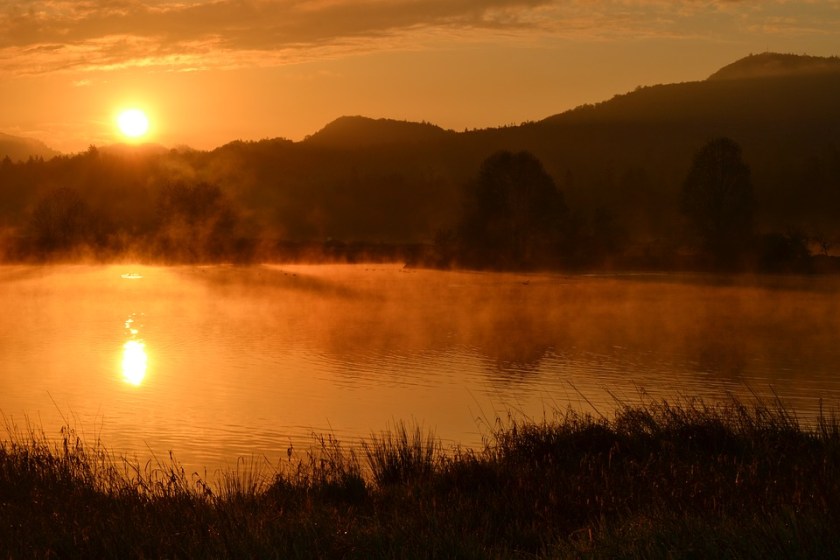
morning fog over a pondSteam, not Smoke

Now the rains have come
and there’s’ no threat of wildfire
for another year, at least, provided
they stay.
May the rains stay.

Coffee cup in hand, I linger over the steam
rising from my reflection-in-brown,
and breathe deep —
Now I can greet a sharp bite
in my nostrils
first thing in the hazy morning
without checking on the waist-high tawny grasses
waving from the hills beyond
my kitchen window.

1994

Copyright © 2017 by Kay Lorraine – All Rights Reserved

Depth Perception - Selected Poems by Kay Lorraine
Depth Perception – Selected Poems by Kay Lorraine

From Depth Perception – Selected Poems by Kay Lorraine


I once had a friend who drew… – a #poem of a different kind of art

I once had a friend who drew
faces for dollar bills for a living.
She said it was more challenging
than most people realized
and more rewarding.
And I wondered if I ever saw her work,
or if she only did 500’s and Thousands.
And I wondered if she made commissions or royalties, or if
she was just a work-for-hire skald
who could only create the big bucks,
not own them.
I think of her often
whenever I pay large bills in cash.
1994

Copyright © 2017 by Kay Lorraine – All Rights Reserved

Depth Perception - Selected Poems by Kay Lorraine
Depth Perception – Selected Poems by Kay Lorraine

From Depth Perception – Selected Poems by Kay Lorraine