Hegel on Knowledge, Impatience, the Peril of Fixed Opinions, and the True Task of the Human Mind – Sharing from Maria Popova @ Brain Pickings

“Impatience asks for the impossible, wants to reach the goal without the means of getting there.”

I frequently lament a particularly prevalent pathology of our time — our extreme impatience with the dynamic process of attaining knowledge and transmuting it into wisdom. We want to have the knowledge, as if it were a static object, but we don’t want to do the work of claiming it — and so we reach for simulacra that compress complex ideas into listicles and two-minute animated explainers.

Two centuries before our era of informational impatience, the great German idealist philosopher Georg Wilhelm Friedrich Hegel (August 27, 1770–November 14, 1831), who influenced such fertile minds as Nietzsche and Simone de Beauvoir, addressed the elements of this pathology in a section of his masterwork The Phenomenology of Mind (public library).

Read the rest of this at: Hegel on Knowledge, Impatience, the Peril of Fixed Opinions, and the True Task of the Human Mind – Brain Pickings

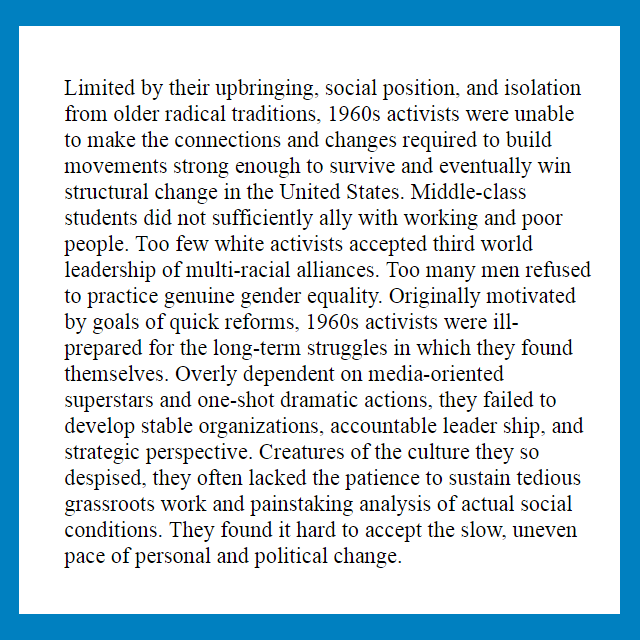
You say you want a revolution? Think about your long game

Excerpt from War At Home
Image content: Limited by their upbringing, social position, and isolation from older radical traditions, 1960s activists were unable to make the connections and changes required to build movements strong enough to survive and eventually win structural change in the United States. Middle-class students did not sufficiently ally with working and poor people. Too few white activists accepted third world leadership of multi-racial alliances. Too many men refused to practice genuine gender equality. Originally motivated by goals of quick reforms, 1960s activists were ill-prepared for the long-term struggles in which they found themselves. Overly dependent on media-oriented superstars and one-shot dramatic actions, they failed to develop stable organizations, accountable leader ship, and strategic perspective. Creatures of the culture they so despised, they often lacked the patience to sustain tedious grassroots work and painstaking analysis of actual social conditions. They found it hard to accept the slow, uneven pace of personal and political change.

I’m working my way through posting excerpts of Strange Bedfellows on this site. The book seems even more apropos now, than ever before, so I’m working my way through it. I hope people will come to understand the underlying message that transcends the story itself. There’s a lot in there. I’ve had 25+ years to think about it, and trust me, I don’t waste time thinking about stuff that has no purpose.

Since the election, there’s been a tremendous amount of dismay, cries for justice, and demands to know “How Can This Happen?”

I’m about as dismayed by anyone, along with not-suprised-at-all. The side of this country that’s come out in the months leading up to the election, and then in the immediate aftermath (hate crimes surged 6%, especially attacks on Muslims, with 300 incidents of harassment or intimidation reported in the seven days following Donald Trump’s election – source Southern Poverty Law Center). Seven days, people. That’s a week.

There’s been a palpable change in the atmosphere. I’m not one to be alarmist, or call out people who stereotypically seem inclined to mis-behave towards others not like themselves (that would be straight, white, middle-class men). But on my conference calls at work, I notice a different tone in the discussions. Men who used to take their turn in the conversations are now dominating. And the way they dominate has changed, as well. Their tone is more imperious, while the things they have to offer are somehow less sophisticated than before.

Then again, maybe they’re just having bad days. Maybe they’re nervous, along with all of us, and that’s how they work it out. I tend to give people the benefit of the doubt. Plus, I’m more sensitive these days, than usual. (Aren’t we all?)

But something feels different.

It feels like we’ve regressed.

Now, mind you, I’m not one of these pie-in-the-sky Obama’s-presidency-made-it-all-better kind of libbral. I’ve never believed we live in a post-racial America. Impossible, is what comes to mind, when I hear people suggest that. It’s hard for me to trust the professed open-mindedness of privileged and entitled individuals, no matter how well-meaning they may be, no matter how closely they may hew to the more genuine side of that fine line that separates “PC” behavior from true consideration and respect for others different from themselves.  It takes a lot to earn my queer trust, my intermittently disabled confidence, my inherently marginalized regard.

Maybe I’m just too cynical. I’ve been battin’ around on this planet for 50-odd years, and maybe my experiences have hardened me. I’ve seen a lot of positive change in the past decades, but I must admit, I don’t expect much. Not from the mainstream, no matter how its members may cast themselves in ally roles in the grand screenplay of my life. People become strangely aloof, when they risk losing something they prize, just because they’re seen with you. Most of all, I’ve been suspect of the supposed normalization of same-sex marriage, nationwide. It’s one thing for my current home state of Massachusetts to legalize and recognize my 26-year committed, monogamous relationship (i.e., allow me to visit my partner in the hospital and help make critical healthcare decisions for her, as well as let me transfer along to her the finances she’s helped me build). But expecting the law of the land to win over the rest of the bright-red country, and warm the cockles of the hearts of the heartland… Yeah, not so much.

Don’t get me wrong. I want to believe. I want to know to the marrow of my bones that people can and will choose dignity over disgrace, and that they truly are capable of change. And I was starting to believe — just a little bit more — when all the polls showed Hillary Clinton well in the lead, and everyone was pretty much taking for granted that she was going to win over her opponent.

But now this. Now the results of the election — which, if you’re paying attention, are so suspect that they bar even the faintest appearance of legitimacy. We were hacked. Repeatedly. And not just during the November election time. For months, it’s been going on. Our national security authorities have said so. Cybersecurity experts say so. And the results from the digital voting machines in counties that had no paper backups don’t even resemble the results of counties next door which had paper ballots as well.

Why are we surprised that the results came out so different than 96.875% of the official pollsters predicted? Why are we surprised at the suggestion we might have been hacked? Why would we doubt it? It just seems so obvious to me. And yet, the disbelief and denial have flowed like rancid milk from a carton dropped on the kitchen floor after it was left in the fridge during a 2-week power cut. Following that disbelief and denial about the kind of world we live in has come a steady stream of calls for normalization from all sides.

People who still believe that “love trumps hate” — and who don’t seem to get that giving your opponent airtime by using his name in your #1 slogan is not a great way to diminish his impact.

People who just want to accept things as they are and move on.

People who can’t fathom just how bad things can get for this country, thanks to the events of this month, and who can’t wrap their minds around the idea that America’s democracy – of all places – could fall to a fascist coup.

People who want to make the best of things, build bridges, find the good in whatever situation comes.

People who don’t want to rock the boat — and end up on somebody’s list that gets them “disappeared”.

In moments like this, I despair. Because this is really nothing other than realpolitik, plain and simple — the cold, hard facts of political practicalities, and what happens when you ignore them. And so many reactions after that obvious travesty of an election result have treated it like it was a final sentence. A done deal.

People, this is not over. The Electoral College still has to vote. Heck, our popular election  was really just an indicator of which way the Electors should vote. There’s no guarantee they’re going to give it to Trump, though it wouldn’t surprise me if they caved and did just that. On top of it all, there are untold numbers of existing and potential legal suits to raise against the prematurely-declared “President-Elect”, despite the insipid sycophanty of people who only a few weeks ago were questioning the mental health of that individual.

My point is, we’re way too quick to just cave. We’ve come a long way from the original settlers (who were no saints, themselves), to the political hothouse flowers we are today. I would imagine the earth above our founding fathers’ (and mothers’) graves is mighty churned up, right about now.

What’s happened to us? Are we really that weak, really that brittle, really that passive, that all it takes is a surprising show of strength (about things which we had every reason to expect)? Why so timid? Why so quick to roll over? It’s like in the quote above, from the online book WAR AT HOME: Covert Action Against U.S. Activists and What We Can Do About It, our progressives simply doesn’t seem to have what it takes to stand up and fight for themselves — or the rest of us — or to even realize that it takes more than eight years of an African-American president to prove America is over its backwards ways.

Thing is, we just can’t seem to figure out how to instill lasting change in our world. Especially from the left. We have some wins, and we shout “Hooray! All better now!” and urge everyone who’s still smarting from the burn of institutionalized racism, sexism, classism, and bigotry of all kinds, to just move on. Deal with it. See? We’re so much more evolved now.

Except we’re not. Not even close. We’ve managed to plaster over the cracks in the structurally unsound lath and whitewash the walls, but the cracks are still there, and the house is still shaky. We’ve managed to make some symbolic gestures that show how much cooler we are with people of color, disabled folks, queers, women, and so forth, and we know how to talk in terms that don’t instantly offend. But the underlying foundation of all this… bullshit… well, that hasn’t actually changed.

And so we find ourselves back in the same goddamned situation as before — only each time, it seems worse. And it is worse. Because while you were celebrating our post-racial world and congratulating yourself for reading writers of color, the KKK was still demonstrating in Lancaster, PA. Disabled folks (especially non-whites) were still getting shot and killed by police officers. Shooters were still stalking law-enforcement and executing them. And no, the Recession is not over. Not by a long shot.

You want a revolution? Then quit talking. Look to the long game. See the ways in which you can extend the significant changes throughout your life. And for God’s sake, don’t just do it because all of a sudden, you got scared or intimidated or had a wake-up call… and then forget all about it, when you start to feel better about yourself and your choices.

Change isn’t something you can instigate, and then leave to flourish on its own. It takes work, it takes commitment, it’s a fucking boring slog much of the time, and thankless most of the time… and unless we keep after it, it cannot last.

So, enough of the wailing and gnashing of teeth. Whatever caused this shit-show, it didn’t just happen overnight. And it’s not going away anytime soon.

What are you going to do about it?

Ancestry discoveries – well, *that’s* interesting!

My Eurogenes K13 breakdown - high level
My Eurogenes K13 breakdown – high level

I’ve had to give up most coffee and all chocolate, because of migraine headaches.

No, I’m not happy about it. The headaches are so much better, but cutting back on those was not my first choice.

I don’t drink alcohol, I don’t smoke anything, and aside from work, I’m running out of vices. Happily, GEDmatch.com has stepped in to fill that vice void.

GEDmatch is a wondrous thing — I can’t stop laughing about how amazing it is. Very simply, you upload your raw DNA data (that you get from Ancestry.com or 23andme.com or some other ancestry DNA service). In a matter of minutes, they parse it all out to tell you what populations your DNA comes from. I’ve spent more hours than I can count, combing through the results. And wonder of wonders, they now have a spreadsheet feature(!) that shows you the “Oracle” breakdown of all your source populations.

That shows you breakdowns by source populations in more detail. The Oracle results show you distances and percentages and the Oracle-4 results give you even more detail around source populations.

You can even choose to see your chromosome makeups.

I ran the numbers the other day, and under the MDLP calculations, I came away with 662 different populations. I studied the list, which was chock-full of all kinds of surprises (including LOTS of Subsaharan Africa DNA). However, it seemed like it might be more “enthusiastic” than is prudent. After a bit more reading online, I discovered that MDLP is not quite as reliable as I’d like. And the Eurogenes calculator was more reliable.

So, of course I re-ran my data through Eurogenes (K13), and I came away with 204 source populations, which seemed more reasonable. But still — all those surprises… including DNA from some of the earliest genomes sequenced, ever. Chances are, we all can trace our DNA back to 7,000 year-old caveman remains with both European and African DNA, but it’s super-cool to see myself connected to that, no matter how distant the connection may be.

The thing that strikes me, as I comb the list of all these DNA influences, is that many of the assumptions I’ve made about my heritage could use some updating. I turned the corner on 50 years, almost a year ago, and I’m thinking more and more about my legacy — what I’ll leave behind me in this world, both while I’m walking around here, and after I’m gone. I’m also thinking about those who have come before me… to see what they may have “left” to me, in terms of personality and character.

I know some are skeptical about the concept of  “cellular memory”, however, intergenerational effects are recognized in terms of emotional resilience and mental health. Plus, recent research has actually shown that daughters inherit corticolimbic circuit attributes from their mothers, and since the biological line from mother to daughter is unbroken, then for sure, women in particular can trace their roots back in a very personal way. Men, too, I’m sure. I just don’t have the research on hand, just now.

I know of one DNA test that looks at mitochondrial DNA — which is passed through the matrilineal line. I think there are patrilineal DNA analyses out there, too — possibly from the same company? And you can trace back your matrilineal heritage, waaaaayyyy back. A friend of mine did that once, and it was very cool hearing about who her foremothers were.

As for me, I’m going to have to do more digging. There are all kinds of surprises in there, for someone who’s always thought of herself in terms of being west-central European — French, German, Italian, Swiss, with a bit of English thrown in for good measure — and not much else.

Turns out, this is my heritage:

Admix Results (sorted):

# Population Percent
1 North_Atlantic 45.35
2 Baltic 21.39
3 West_Med 15.66
4 West_Asian 8.51
5 East_Med 7.49

204 populations found.
13 components mode.

The Baltic, West Asian, and Eastern Mediterranean are big surprises.

And when I dig into the 204 distinct populations, I find a whole lot of surprises. Including many, many Siberian influences, and Eastern European sources, many from along the Volga river. And then there’s the Brahmin from Uttar Pradesh. And Papua. Maasai. Yoruba.

How very cool is that?

And so the quest commences.

Change of season, change of pace… and using it well

Nauset-Light-BeachI almost drove out to Nauset Beach today. It’s an amazingly gorgeous day, bright and sunny, not a cloud in the sky. The perfect sort of weather to head to the beach.

Nauset Beach on Cape Cod is about 2 hours from my house. 2 hours and 4 minutes, according to Google Maps. And considering I was up early today, and I didn’t really have any hugely pressing duties that MUST be done today, I figured I could drive the 2 hours (and 4 minutes), arrive before noon, eat the lunch I packed, walk the beach, explore the areas that were carved away by winter storms, and get back home no later than 10 p.m.

It’s Saturday. If the day runs late, I can always make up for lost sleep tomorrow.

That was my thinking, anyway.

herring cove sunset
Another amazing sunset in Provincetown

When Laney and I were out in Provincetown, a few weeks back, we chatted with someone who lived in the area who told us winter storms had carved huge chunks of land off Nauset Beach. There were sections blocked off. Caution tape up. Facilities that weren’t accessible. I wanted to stop and take a look on our way home from P-town, but it was a rainy day, and we just wanted to get down the road. So, I didn’t get to take a look.

dunes-erosion-grass-roots
Woody dune growth, with their roots all exposed. Bunches of this had uprooted and were lying down the beach a ways.

I’ve been  feeling disappointed about that, because while I was walking the beach at Herring Cove towards Race Point, I saw so much erosion, it was crazy. It was — as the fellow we’d chatted with put it — “like the hand of God reached down and just scooped it all away.” Dunes were eroded so far down that driftwood buried for many years was exposed, poking out of the side of the washed-away dune, a foot or so beneath the surface where the grass was growing.

Parking lot erosion @ Herring Cove North

Half the parking lot was cordoned off, because it wasn’t safe to park there.

A lot of the parking lot was just gone.

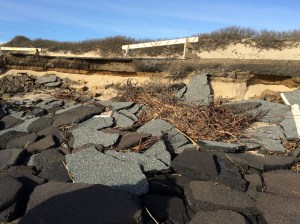
Massive swathes of asphalt had been undercut and just buckled and fell away… then washed on down the beach. Or out to sea. There was a lot of asphalt unaccounted-for.

herring-cove-asphalt-erosion1
The asphalt looked like it had melted on someone’s dashboard

And up at the bathhouse area? Well, that beautifully constructed deck and walkway leading down to the beach for folks with limited mobility… that’s gone.

dunes-erosion
Dune erosion – near where we used to build our fires

The spot where Laney and I built many a beach fire, not far from the end of the walkway? That was gone, too — as though it had never existed.


And even more remarkable — all those colorful stones and pebbles that have been the hallmark of Herring Cove South… gone. Washed out to sea. I think they got washed away a couple of years ago, but this year, it was even more noticeable… perhaps because of all the dunes erosion.

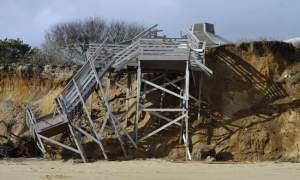
Damage to the stairs at Nauset Beach - no, this isn't my picture (click the image to see a gallery of pictures)
Damage to the stairs at Nauset Beach – no, this isn’t my picture (click the image to see a gallery of pictures)


So, of course I wanted to get a look at Nauset Beach! It wasn’t enough to look online. I wanted to stand there and look at it – in person. I wanted to feel the sun on my back, the wind in my face, the sand under my feet. I wanted to hear the splashing of the surf, the calling of the gulls, and spot the occasional beach walker bundled up against the wind. Maybe I’d get pictures. Or maybe I’d just stand there and look at it, shaking my head. I wanted to see for myself what the hand of God had been up to, and marvel at it, just as I’d marveled at the damage at Herring Cove.

There was just one problem. I was bushed. I’d had a pretty long week, and I sorely needed to catch up on my sleep. Nothing kills a weekend more than being dragged down by a sleep deficit, and I’d actually been planning to catch up on my ‘zzzs’ today — and tomorrow.  And nothing turns a 2-hour drive to the beach into a chore, like being tired. I actually did pack a lunch and was almost ready to go, but really, I was way too tired to do anything.

So I went back to bed.

A couple hours later, I woke up and looked at the clock. I could still make it to the beach and have at least 4 hours of daylight to enjoy. On the beach. Seeing the sights. But was it worth losing all that time to driving?

Not really.

Long story short, I made the best of my time at home. I got my yard raked. Dead grass has been pulled up to make room for new growth. Leftover leaves have been removed from the garden areas, and the deadfall in the front yard has been thrown into the woodsy no-mans-land between my house and the neighbor’s. The chokecherries that have been encroaching on the pines in the front, as well as getting a foothold all along the front stone wall (nasty thorny bastards!), are now trimmed back and tossed aside. And the trees that sprouted a few years back and were starting to get a foothold in places they shouldn’t be, have been cut and piled in the side woodlot.

And so, for me, spring has officially begun. With work. And with plenty of time to think. Yard work is a kind of meditation for me — a moving mindfulness practice that always brings new thoughts to mind as I tend the land around my home. Some folks hate yard work, but for me, it’s a reminder of just how fortunate I am to live where I do – and how I do. It gets me thinking. As I rake and collect and toss and mend, it frees up a whole lot of ideas that normally don’t come to me.

This year is seeing a lot of changes for me. People are moving in and out of my life. I’m losing people I care about, and I’m gaining new people whom I will eventually care about. My work situation is… well… interesting, as we go through a merger that has a lot of people asking a lot of questions, without many definitive answers, yet. And my own focus is shifting more squarely toward my writing and publishing, as I dig out manuscripts I started years ago… then put aside to tend to the day-to-day.  There’s a lot of decent material there — at least five full-length works that are “written” in my head, but still need the words on paper. Novels. Essays. Philosophy. A play. And yes, some poetry.

As I was hacking away at the chokecherries, it occurred to me that although the books awaiting my attention are all about different things, they’re essentially about the same topic: Change. How we handle it. How we prepare for it. How we avoid it. How we embrace it and manage it, or fight it every inch of the way.  What it brings to us. What it takes from us. It’s all about change, with me. And it has been for many, many years.

So, that was a productive use of time. I got my yard tidied up, and I got some good revelations. Sure, I would have loved to see Nauset Beach and how it’s weathered the seasons. But I was welcoming my own new season.

Right here, at home.

A welcome reminder of how much myth matters to me

books-dustySo, just by chance, a couple of weeks ago, I accompanied my partner Laney to the annual conference of The Association for the Study of Women and Mythology.  A few months ago, Laney had gotten a (surprise, last-minute) email from a colleague about how the conference was still accepting applications for workshops and presentations… and would she be interested?

Well, yeah. Of course she was interested.  It was a conference of several hundred women, all gathering to talk about women… and mythology. Laney’s an incredible drum circle leader and ceremonialist, and we both thought her work would fit just perfectly into the program.  Lots of academics sharing papers and discussing their areas of study… and surely there were some women in the midst who could go for an “extra-intellectual” activity (“extra” as in, “outside the immediate purview” of intellectualism — not uber-intellectual).

Anyway, we scrambled a bit, put together a write-up of what she’d offer, then we crossed our fingers and — voila — before long, we heard she’d been accepted.

Then came the coordination activities. And the logistics. And making sure that the drum ceremony would not drown out the goings-on in adjacent rooms. And lining up  help to get the room setup, because it’s a conference, after all, and there is a schedule to adhere to. We got pretty much everything sorted.

Or so we thought. Turns out, the original schedule we mapped out just wasn’t going to work. More juggling. More adjustments.

Anyway, long story short, everything turned out great, because I managed to get a day off work (paid vacation days are a thing of beauty), so I could help her load in and load out on Friday afternoon. Drums, drums, and more drums — including the “mother drum” which is a large “community” drum, about 3 feet wide and nearly 2 feet tall, and comfortably sits 5 people around it. It takes a special sort of maneuvering to get where it needs to go, and I’ve had years of practice, so off I went to drive Laney there, catch up on my reading, then help with the ceremony, load out, and ferry us home.

My plan all along was to help with logistics, and then take the hours that I wasn’t at the conference just for some of my own work. I had some reading to catch up on. I had some writing to do. I hadn’t paid the money to join in, and it wasn’t cheap, so I figured I could just linger in the halls, curled up with a book in a spare armchair.

And I did a fair amount of that. At least, as much as I could, considering that I kept seeing old friends I hadn’t seen for a number of years, and of course we wanted to catch up.  Of course! It was great to see people again, and a bit surprising — although it shouldn’t have been, considering that I have a bunch of friends who are into women and mythology.

I guess I just had a fairly narrow view of who would be at the conference. Lesson learned.

And as it turned out, I had a fairly narrow view of how much I would be interested in the conference. I mean, yes, I’ve been fascinated by mythology in general (and women in mythology, in specific) for just about all my life. But for some reason, I didn’t think I’d really find it that interesting. Looking at the program, it was chock-full of some heavy-duty scholarship… far beyond the scope of my own interest and involvement. Maybe I figured that if I didn’t have all the degree letters after my name, I somehow wouldn’t qualify to attend, let alone participate in any of the discussions.

Gluehende_KohleA funny thing happened, though, just from hanging around the fringes of the conference.  As it turns out, I was interested. And I’ve actually become increasingly interested, over the course of the past couple of weeks. It got me thinking. It got me remembering. And beneath the shiny veneer of a life that’s more about modern technology than ancient mythology, these days, I actually found a glowing coal of interest that has stayed alive — banked in the backwaters of my full spectrum of interests.

And calling that interest — that passion — in mythology “banked” is the perfect metaphor. When you bank a fire, you cover it up with the ashes its produced, keeping it alive and glowing, till you come back to it later. I’ve heard tell that people used to travel with banked coals in a little tree bark container, so they could have fire wherever they were.

As it turns out, I hadn’t lost my interest in mythology and symbolism, as I tended to think while regarding my bookshelves sagging heavily under the weight of myths from vanquished and long-forgotten peoples. I’d just banked it. And it’s still very much alive. It still burns beneath the accumulation of extras from my necessary life, waiting for me to breathe new vigor into it and warm the rest of my everydays.

Myth still matters to me. As does symbolism. It’s never stopped mattering to me, I just got busy doing other things. And now those other things turn out to mean a lot less to me, than mythology always has. Life changes. We change. We shift and find new directions to take. Sometimes life brings us full circle, to remember just what used to light our fire — and still does.

Here’s to life. And all that it offers. Especially our stories.

The Voice of Night – Reclaiming the Castle

woods-clearingI had a remarkable dream, one night. I dreamed I was attending an herbalist convention, held at a camp in the middle of a northeastern forest. There were both men and women there, all of us deeply committed to the healing arts. The main lectures took place in a medium-sized camp hall, where about nine rows of folding chairs were set up in front of a podium. There were other workshops and classes on the schedule, in other small buildings around the camp. But the main discussions and speeches took place in that main hall.

I had been listening to lectures about herbs all day, and I was tired of so many words. So, I got up and took a walk in the woods to stretch my legs. I walked a long way, through the hardwood forest, the ground soft with many seasons of fallen leaves, as well as the ferns and moss common on the Eastern Seaboard. I walked farther than I realized, though, and soon I found I was lost. I stopped and looked around, but could see nothing but trees, could hear nothing but the wind stirring in the leaves, as well as little creatures scampering across the forest floor.

As I turned and looked around, I suddenly caught sight of a part of the ground that seemed to be dug up, off at a distance of some 100 yards. I walked closer to it, wary, but I could see or hear no other humans or sign of danger. As I came closer, I realized it was a huge pit dug in the forest floor — rectangular and stone-lined, it reminded me of an immense swimming pool, or an inverted castle submerged in the ground. The top of the pit was flush with the forest floor, and it went down many feet into the earth. The stones that lined it were perfectly cut and set together, and the whole structure was about 20×30 yards in size. I crept closer and closer to it, still not certain what this was. As I came to the edge, I looked down, and saw it had water sitting in it. I couldn’t tell how much, but there was a good deal — brown, almost brackish, but surprisingly inviting.

For some reason, I thought it would be refreshing to take a dip in this pool in the middle of the woods. I wasn’t sure why, but it beckoned to me. I was hot and sweaty and stiff from sitting all day in that camp hall, and a swim seemed like just the thing. If I got dirty from the water, I thought, I could always go back and wash off. I jumped in with my clothes on.

The moment I hit the water, I was flooded with an intense sensation of wholeness. It wasn’t just a sense of well-being — it was intense and almost overwhelming sense of oneness, of fullness and no awareness of lack or limitation of any kind at all. I was free. I splashed around in the water, did backstrokes and somersaults, and paddled around, filled with a sense unlike anything I’d ever had before. My whole being was suffused with a sense of peace, safety, well-being — a Divine sense of consummate satisfaction that calmed every irritation and smoothed every wrinkle of worry from my being. I could hardly believe it. This brackish water, which at first sight looked tainted with rotting leaves, filled me with joy beyond any expression.

I swam from one end of the pool to the other, testing the depth of the water. In one place, it would be six inches deep, in another it would be too deep for me to reach the bottom. Every square yard of the pool had a slightly different bottom, and I tested the depths with serene pleasure. I splashed and dove and played for almost an hour.

Then I decided it was time to get out. It was getting dark, and I thought I’d better get back to my conference and finish out the day’s lectures. I pulled myself out of the pool, dripping, blissful, and amazed at the experience. I could hardly believe this had happened to me, and I thanked whatever or whoever had led me there, for allowing me to experience this bliss.

I looked up, then, and saw two women watching me. They were middle-aged, with long, grey-streaked hair filled with twigs, leaves, and moss. Their faces were smudged, and they wore long burlap-like dresses that were tattered around the edges. Their skin was weathered and dark, but their eyes were clear and bright. They introduced themselves to me as the ones who were excavating this ‘site’. They said they were anthropologists who had been searching for Camelot all their lives, and they finally located it here. “That pool you were swimming in,” they said, “is Camelot. It’s always been here, and it’s still here for anyone who needs it.”

I was flabbergasted, speechless. I didn’t know what to say. They told me that they’d been working on this dig for years, now, and it was finally ready for others to experience. It was time to start telling people about it. They said I should go back to my workshop and not hide what I’d found. At the same time, though, I shouldn’t tell just anyone about this place. “Not everybody is ready for this,” they said. “Not everybody will want it, either.” I couldn’t imagine anyone not wanting what I’d found here, but they insisted I be selective in whom I told, while not being reluctant to discuss Camelot with those who were genuinely interested. Then they told me to go back, and I bid them good-bye. I said I would see them later, and they said, perhaps I would.

I returned to the camp, my clothes dry from walking briskly. When I got back, I could hardly wait to tell people about my experience — yet I wasn’t sure whom to approach. Besides, it was time for the keynote speaker, Patrick Stewart, the actor who plays Captain Jean-Luc Picard on the television show, “Star Trek – The Next Generation”. My head was in a whirl the whole time he spoke, but I picked up some of what he said.

He told us that although he played a starship captain on television, we herbalists were actually doing the same work as his co-players on the show — making inroads in whole new areas of life, and making it possible for humanity to expand beyond its own limitations. “You are the real thing,” he said, “and your work is as vital as my role on television seems.” His words sent a thrill through the audience, and we knew he was right — we were doing important work. Yet all the while he was speaking, he seemed distracted, tired, weary, and frightened. He seemed totally depleted, and although his words had the ring of truth, they came from a taxed and worn soul.

When he was finished speaking, we jumped to our feet, applauding. He stepped back from the podium, drawn and pale, and the audience broke up. Some gathered together in groups around the room to discuss the conference, while others of us went up to Patrick to shake his hand or ask him questions. He was polite to everyone, yet distant.

I stayed at the edge of the crowd surrounding him, waiting my turn to speak with him. When most of his admirers had praised him and moved on, I approached him and thanked him for his talk. “But I want to give you something back,” I said. “I just want you to know that Camelot is here. It’s not far away in some star system, it’s not halfway around the world. It’s here. I’ve been there just today, and I can show you where it is. We can go anytime.”

At that, Patrick fixed an intent gaze on me, disbelieving. “It’s here,” I said again. “We can go to it anytime you like. Right now, if you want.” All the hardness and tired lines faded from his face, and he broke down and began to cry. He cried very hard, like a little baby, holding his face in his hands, his shoulders shaking, while people around the room looked over at him, surprised and wondering. Some came over to see what was going on. After a few minutes, he collected himself and looked up at me and asked me where it was. He appeared hopeful for the first time all evening. Others around the room said, “Yes, where is it?” and came over to hear the answer. I told them where, and they all looked at each other with wonder. They couldn’t believe Camelot was so close, but I assured them that I had been there.

Some in the room heard what we were saying and turned away. They had no interest in going to see the place or experiencing it, and they said as much. They just wanted to discuss what they’d learned that day in their classes. They were hungry, or they were tired, or they just weren’t interested. They didn’t begrudge us our enthusiasm, just moved off in their little groups to get an evening snack in the cafeteria, or get ready for bed.

Those of us who did want to go to Camelot began to move out in clusters. I gave instructions on how to get there, and in small groups, we moved out — some racing at top speed, some going at a measured pace, others stopping to get their swimming suits or talk some more. I went with Patrick Stewart and a small group of women. As we approached the place in the woods where the pool was, we could hear laughing and splashing. Patrick’s demeanor was becoming lighter all the time, he had a spring in his step, and he was now talking animatedly, joking with the women in our group. We came near the pool and could see through the trees a luminous shining surrounding the pool, as some of my fellow students leaped and dashed and splashed into the water in hilarious ecstasy. Others stood around the edge of the pool, watching and enjoying themselves at the sight. Off to the side, I saw the two women who had unearthed this treasure. They nodded to me as I came near and smiled appreciation and approval to me.

I knew then, I had done the right thing. I ran to join the others in the pool, just as Patrick dove into the water that would renew him.

 

The Voice of Night – Dreams from a Dreaming Past

'Dream_of_Italy'_by_William_Louis_Sonntag,_Dayton_Art_InstituteStrange Bedfellows isn’t the only epic dream I’ve had. I’ve had many, many complex, involved dreams over the course of my life. Maybe it’s my personality, maybe it’s my biochemistry, maybe it’s my “wiring”, but there’s some pretty wild stuff that’s showed up while I’ve been sleeping.

Years ago (like, about two decades ago), I posted my dreams as “The Voice of Night”. And that was actually one of the first websites I created, back when the web was young. That site went away, eventually, as early web things often do.

But the dreams all stayed on my hard drive. In html. Waiting to be brought back to the light of day.

Now seems like as good a time as any to do it, since I’m talking about dreams a lot, these days… as well as life lessons. The lessons still hold true. And many of them are actually even more pertinent today, than they were when they first came to me.

It’s going to take some time to post them all. But it’ll be a great way to pass the time 🙂

You’ll find them here, as I re-release them back into the wild:  The Voice of Night – A Personal Mythology of Dreams


Last two poetry books updated – now on to Strange Bedfellows.. and beyond

woodtypeOkay, so that’s done.

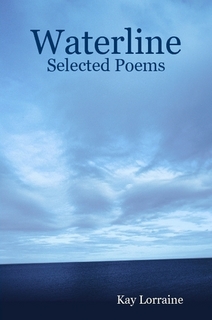
I just updated the last two poetry books I published. It’s not difficult – just a lot of attention to detail. Changing half of your name, and then updating everything accordingly, can get a bit eye-crossing. Especially if there are ebook versions, as well as print versions. I still haven’t decided what to do about the ebooks. The name will have to change there, as well.

Just when it seems I’ve gotten everything fixed… I find something else. So, I check, and check, and double-check. Especially because I’ll be publishing to Amazon and other international distributions, which means I need to ensure everything – but everything – is pristine and perfect. Once you put an ISBN to something and publish it via international distribution, you’re locked in. So, you have to make it count.

Again, it’s eye-crossing.

But now, it seems it’s all set.
waterline-coverparadise-cover

I’m digging into Strange Bedfellows, now. From a logistical standpoint, the work is more painstaking, because the file is bigger and takes longer to save. Plus, it’s chock full of images, which now and then have a tendency to shift around on the page – and then throw off the page count. Fortunately, I’m working in Open Office, so the file formats are the same (No M$FT Word for me, thank you very much). Plus, Open Office file sizes are a lot smaller, so there’s less drain on my finite system resources.

And that’s always nice.

If you have the proper tools, you can do amazing things. And if you practice good attention to detail, you can really create some professional-looking products that anybody would think are commercially produced. That’s one of the benefits of having worked in publishing before — both print and digital. You pick up tips and tricks, plus you develop an eye for the kind of detail that goes into creating quality materials.

Some people think that you have to have access to money and contacts and resources, in order to produce professional-looking books. On the contrary, I’ve been doing “guerrilla” publishing since the 1980s, and some of my “amateur” works look just like what you’d find in the bookstores. If you have the desire and you keep at it and you set your sights high –and never give up till you create exactly what you want — great things are possible.

If there’s one thing I’d want people to know about putting their own writing out there, it’s that. What I said above. I’ve come across a lot of people who have either had a sour-grapes attitude (“Well, of course you made something nice – you work for a big company and have access to their equipment!”), or a sort of resigned approach (“I don’t need anything fancy, just some copies made up at the local office supplies store.”)

I disagree on both counts. First off, my books don’t look great because I use my employer’s stuff. I don’t. I’ve figured out how to either use what little I have very creatively, or I found a way to get access to the equipment I needed on an occasional basis. You don’t need to have constant access to a full-feature printer, to crank out a handful of poetry chapbooks. You can mock everything up at the local library, print it out for 10 cents/sheet, and then take it to your local copy shop to create the finished product.

If you want to publish full-length books, you can do it for free at Lulu.com. They have everything you need to publish a full-length book with a nice-looking cover, and it won’t cost you a think to set it up. You can do the pre-production work on the computers at your local library.

As for “keeping it simple” and going with a bare-bones approach… It’s so straightforward, and so possible, to produce a really nice-looking work on your own, that there’s really no reason to do without good design. All you need for inspiration and guidance, is a trip to your local bookstore or library, to see examples for best-practices in book design and layout. And then you just copy what they do.

It’s really quite simple. But a lot of people make it hard in their heads.

Far more important than expensive equipment or professional publishing skills, is a keen sense for detail and what makes a published product look — and feel — great. Once you’re clear on that, everything becomes a lot clearer.

Now… on to updating Strange Bedfellows.  I’m writing a new foreword, as well as a conclusion. The story, on the surface, reads like an eco-warrior treatise about the hazards of modern living. But beneath it all, there’s more… so much more.

And there will be more to come about that. Soon.